
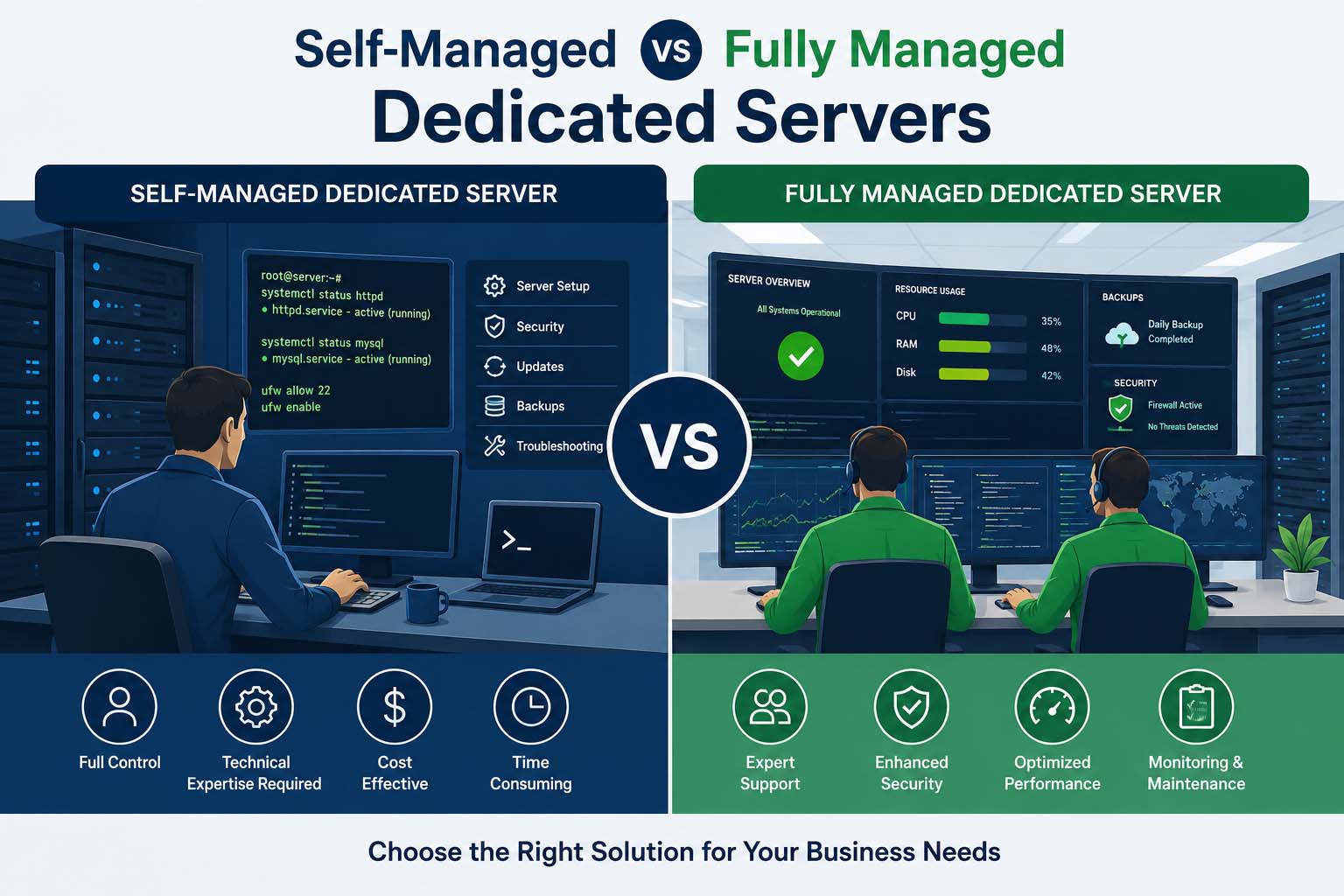
When it comes to hosting business-critical websites, applications, or high-traffic platforms, dedicated servers offer unmatched performance, security, and control. But one of the biggest decisions businesses face is choosing between a Self-Managed Dedicated Server and a Fully Managed Dedicated Server.
Both options provide dedicated resources and enterprise-grade infrastructure, but the level of technical support and server management differs significantly.
In this guide, we’ll break down the differences, advantages, and ideal use cases to help you choose the right solution for your business.
What is a Self-Managed Dedicated Server?
A Self-Managed Dedicated Server gives you full control over your hosting environment while leaving server administration responsibilities in your hands.
This option is ideal for experienced system administrators, developers, or businesses with an in-house IT team capable of managing server operations independently.
With self-managed hosting, the provider typically handles:
- Hardware setup
- Network connectivity
- Basic server deployment
- Control panel installation (optional)
Everything else — including security hardening, performance optimization, monitoring, backups, and troubleshooting — is managed by the customer.
Best For:
- Developers and Linux administrators
- Businesses with internal IT teams
- Advanced users needing complete control
- Cost-conscious hosting environments
What is a Fully Managed Dedicated Server?
A Fully Managed Dedicated Server includes proactive server management and expert technical support from the hosting provider.
Instead of handling complex server administration tasks yourself, experienced engineers take care of:
- Security management
- Performance tuning
- Backup configuration
- Monitoring
- Malware scanning
- Service optimization
- Technical troubleshooting
This allows businesses to focus on growth while leaving server management to professionals.
Best For:
- Business websites and eCommerce stores
- Agencies managing client websites
- Companies without dedicated server admins
- Mission-critical applications
- Users wanting peace of mind
Self-Managed vs Fully Managed Dedicated Server Comparison
1. Server & Application Setup
| Feature | Self-Managed | Fully Managed |
|---|---|---|
| Basic server setup with pre-installed control panel (cPanel/Plesk) | Yes | Yes |
| Apache, DNS, FTP, Mail, PHP & MySQL configuration | Yes | Yes |
| Local & offshore backup configuration | No | Yes |
| FTP & email client setup assistance | No | Yes |
| Third-party application installation (WordPress, Magento, CloudLinux, Softaculous, etc.) | No | Yes |
Key Difference
With a fully managed server, your hosting provider helps configure essential services and applications, reducing technical workload and setup time.
2. Migration Assistance
| Feature | Self-Managed | Fully Managed |
|---|---|---|
| cPanel-to-cPanel website migration assistance | Limited / tenure-based | Yes |
Key Difference
Fully managed hosting usually includes seamless migration support, minimizing downtime and technical complications during server transfers.
3. Security Management
| Feature | Self-Managed | Fully Managed |
|---|---|---|
| Security patch installation | Yes | Yes |
| Server hardening & SSH security | No | Yes |
| Firewall configuration & IP blocking | No | Yes |
| Malware scanning & security audits | No | Yes |
| Spam review & IP delisting assistance | No | Yes |
Key Difference
Security is one of the biggest advantages of managed hosting. Fully managed servers receive proactive monitoring and security improvements based on industry best practices.
4. Performance Optimization
| Feature | Self-Managed | Fully Managed |
|---|---|---|
| Apache, MySQL & PHP optimization | No | Yes |
| Disk space monitoring & audits | No | Yes |
Key Difference
Managed servers are regularly optimized for better speed, stability, and performance, helping websites load faster and operate more efficiently.
5. Server Monitoring
| Feature | Self-Managed | Fully Managed |
|---|---|---|
| Core service monitoring (HTTP, MySQL, FTP, SSH, DNS, etc.) | No | Yes |
| Server load & disk usage monitoring | No | Yes |
Key Difference
Fully managed servers are continuously monitored, allowing support engineers to detect and resolve issues before they impact your services.
6. Technical Support
| Feature | Self-Managed | Fully Managed |
|---|---|---|
| Hardware & network issue assistance | Yes | Yes |
| Extended technical support | No | Yes |
| Website & database restoration | No | Yes |
| Coding-related troubleshooting | No | No |
Key Difference
Self-managed plans typically include only infrastructure-level support, while fully managed plans provide advanced server administration assistance.
Advantages of Self-Managed Dedicated Servers
Lower Cost
Self-managed hosting is generally more affordable because server administration is not included.
Full Administrative Control
You have complete freedom to configure software, security rules, and server architecture exactly as needed.
Ideal for Experienced Users
Advanced users can customize the environment without restrictions.
Advantages of Fully Managed Dedicated Servers
Expert Technical Support
A professional support team handles server-related issues, maintenance, and optimization.
Better Security
Managed security practices help protect your server from vulnerabilities, malware, and attacks.
Reduced Downtime
Proactive monitoring and rapid troubleshooting help maintain higher uptime.
Saves Time
Businesses can focus on operations instead of managing server infrastructure.
Which Dedicated Server Option is Right for You?
Choose Self-Managed Dedicated Hosting If:
- You have Linux/server administration experience
- Your company has an internal IT team
- You prefer full control over configurations
- You want to reduce hosting costs
Choose Fully Managed Dedicated Hosting If:
- You lack technical server management expertise
- Your website or application is business-critical
- You need proactive monitoring and security
- You want professional assistance with maintenance and optimization
Final Thoughts
Both self-managed and fully managed dedicated servers offer powerful hosting environments with dedicated resources and high performance.
The right choice depends on your technical expertise, business requirements, and how much time you want to spend managing infrastructure.
If you prefer flexibility and have the technical skills to manage everything yourself, a self-managed server can be a cost-effective solution.
However, if reliability, security, expert support, and peace of mind are priorities, a fully managed dedicated server is often the smarter long-term investment.
Need help choosing the right dedicated hosting solution? Contact our hosting experts today and we’ll help you find the best server configuration for your business needs.
