
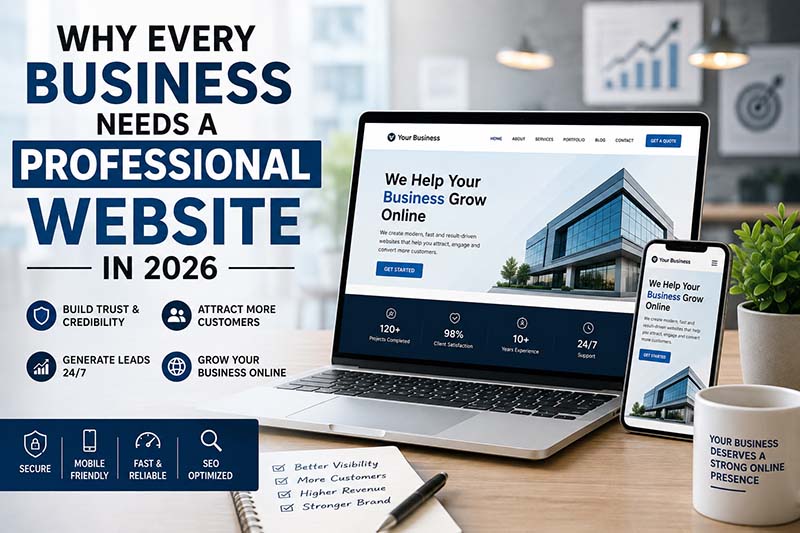
In 2026, a professional business website is no longer just an advantage—it is an essential part of establishing a credible online presence. Professional website design helps businesses present their brand clearly, build trust, improve usability, and create a better experience for potential customers.
Customers increasingly search online before contacting a company, visiting a store, requesting a quotation, or making a purchase. They may discover a business through Google Search, Google Maps, social media, an advertisement, or a recommendation, but the company’s website often becomes the place where they look for more information.
A social media profile can help a business reach people, but a website gives the business a dedicated digital presence that it controls.
Whether you run a local shop, professional practice, manufacturing company, restaurant, consultancy, educational institution, startup, or service business, a professional business website can help you build trust, communicate your value, generate enquiries, and support long-term growth.
Google also allows eligible businesses to display their website, contact information, opening hours, location, photos, reviews, and other details through Google Business Profile, making a website an important part of a broader local online presence.
What Is a Professional Business Website?
A professional business website is more than a collection of pages containing your company name and contact number. It should be designed around your customers and business objectives.
A good business website should generally provide:
- Clear information about your products or services
- Professional branding and visual design
- Easy navigation
- Mobile-friendly layouts
- Fast page loading
- Secure HTTPS connections
- Clear contact information
- Strong calls to action
- Search-engine-friendly structure
- Useful and original content
- Reliable hosting
- Regular maintenance and security updates
Most importantly, the website should answer the questions a potential customer has before deciding whether to contact your business.
Why Every Business Needs a Professional Business Website
1. Your Website Builds Trust and Credibility
Imagine two businesses offering the same service. One has a professional website with clear information, photographs, services, customer testimonials, contact details, and a consistent brand identity. The other has only a social media profile with occasional posts and limited business information. Which business would you trust more? Your website is often one of the first places a potential customer evaluates your business.
A professional website can communicate:
- Who you are
- What you offer
- Where you operate
- How customers can contact you
- Why customers should choose you
- What experience you have
- What previous customers say about you
This doesn’t mean an expensive website automatically creates trust. Clear information, genuine content, good usability, security, and consistent branding matter more than simply having an impressive visual design.
2. Customers Search for Businesses Online
Consumer behavior has changed significantly.
Before calling a company, many people first search for:
“best [service] near me”
“[company name]”
“[product] supplier in [city]”
“[service] price”
“[business] reviews”
Your website gives search engines additional information about your business and provides potential customers with a destination where they can learn more.
For local businesses, a properly maintained Google Business Profile can also help customers find the business through Google Search and Maps. Google specifically notes that Business Profiles can help customers discover businesses and visit their websites.
3. A Website Works 24/7
Your physical office or shop may have fixed working hours. Your website doesn’t. A customer can visit your website at:
- 7 AM
- 11 PM
- On weekends
- During holidays
- From another city
- From another country
Your website can continuously provide information about your business even when your employees are unavailable. For example, a customer can read about your services at night and submit an enquiry form. Your team can respond the following morning.
This turns your website into a 24/7 information and lead-generation channel.
4. Your Website Can Generate Leads
A website shouldn’t simply tell people that your business exists. It should encourage visitors to take the next step. Depending on your business, this could be:
- Call your business
- Send an enquiry
- Request a quotation
- Book an appointment
- Start a WhatsApp conversation
- Purchase a product
- Download a brochure
- Subscribe to updates
- Visit your physical location
Clear calls to action can turn website visitors into potential customers.
For example:
Need a quotation? Contact us today.
is much more useful than simply displaying:
Contact Us
5. Your Website Supports Google Search and SEO
Search Engine Optimization (SEO) helps search engines understand your website and helps potential customers discover your pages through relevant searches. A professional website gives you a foundation for SEO.
You can create dedicated pages for:
- Products
- Services
- Locations
- Industries
- Frequently asked questions
- Guides
- Case studies
- Blog articles
You can then optimize these pages around the questions and terms your customers actually search for.
Google recommends creating helpful, reliable, people-first content and using words that users are likely to search for in important areas such as titles, headings, link text, and image alt text. SEO is not simply about inserting keywords repeatedly.
A useful website should provide genuinely helpful information that satisfies the visitor’s intent.
6. You Own Your Website
One of the biggest advantages of having your own website is control.
Social media platforms can change:
- Algorithms
- Advertising rules
- Features
- Organic reach
- Account policies
- Content formats
Your business shouldn’t depend entirely on another platform to maintain its online presence.
Social media is valuable, but your website can serve as the central digital property that connects your other channels.
For example:
Google ? Website
Instagram ? Website
Facebook ? Website
Online advertisements ? Website
Email campaigns ? Website
Instead of sending customers to several unrelated platforms, you can direct them toward your own digital home.
7. A Website Strengthens Your Brand
Your website provides much more control over how customers experience your brand.
You can establish consistent:
- Logo usage
- Colors
- Typography
- Photography
- Brand messaging
- Product presentation
- Company story
- Tone of communication
This becomes particularly important as your business grows.
A professional website can make a small business look established while giving an established company a more consistent digital identity.
8. Your Website Can Support Digital Marketing
A website is the foundation for many online marketing campaigns.
For example, you can run:
Google Ads
Send advertising traffic to a dedicated landing page.
Social Media Advertising
Send visitors from Instagram or Facebook to a service or product page.
Email Marketing
Send subscribers to useful articles, offers, products, or enquiry pages.
SEO
Attract visitors through organic search.
Content Marketing
Publish helpful guides that answer customer questions.
Without a website, many of these campaigns have nowhere suitable to send interested customers.
9. A Professional Website Improves Customer Experience
A website should make it easy for visitors to find what they need.
Good website usability includes:
- Simple navigation
- Clear headings
- Readable typography
- Mobile responsiveness
- Fast loading
- Accessible contact information
- Logical page structure
- Clear calls to action
A beautiful website that is difficult to use isn’t necessarily a good website.
Design should support usability, not replace it.
10. Mobile-Friendly Design Is Essential
A significant portion of website traffic comes from smartphones. That means your website shouldn’t simply be a desktop website squeezed onto a mobile screen. A professional website should adapt to different screen sizes.
Visitors should be able to:
- Read your content comfortably
- Navigate menus
- Tap buttons
- Submit forms
- Call your business
- View images
- Complete purchases
without constantly zooming or scrolling sideways.
Mobile experience is especially important for local businesses because customers may discover a company while they are already outside their home or office.
11. Website Speed Matters
A slow website can frustrate visitors before they even read your content.
Common causes of slow websites include:
- Poor hosting
- Unoptimized images
- Excessive JavaScript
- Poorly coded themes
- Too many plugins
- Missing caching
- Inefficient databases
- Unoptimized third-party scripts
Website performance should therefore be considered during development rather than treated as an afterthought.
Our recent guide on web hosting in Indore also explains how hosting infrastructure can affect website speed, reliability, and security.
12. Security Should Be Part of Website Development
A professional website should not only look good—it should also be protected.
Security considerations include:
- HTTPS/SSL
- Strong administrator passwords
- Secure hosting
- Regular software updates
- Backups
- Malware monitoring
- Firewall protection
- Secure forms
- Access control
This becomes particularly important for WordPress websites.
We recently published a detailed guide explaining how to protect WordPress from hackers, including updates, strong authentication, firewalls, backups, malware scanning, and other security measures.
Security should be considered from the beginning rather than after a website has already been compromised.
13. Your Website Can Grow With Your Business
A good website should not become obsolete as soon as your business expands.
You may eventually need:
- New services
- New locations
- Online payments
- Customer accounts
- Booking systems
- Product catalogs
- E-commerce
- CRM integration
- WhatsApp integration
- Automated forms
- Custom web applications
Choosing the right technology and architecture from the beginning can make future expansion easier.
For businesses experiencing rapid growth, infrastructure also becomes important. Our recent articles on VPS hosting and cloud hosting explain how businesses can move beyond basic shared hosting as their technical requirements increase.
14. Your Website Can Reduce Repetitive Customer Questions
A well-structured website can answer common questions before customers contact your team.
For example:
A service company can explain:
- Services offered
- Service areas
- Pricing information
- Process
- FAQs
- Expected timelines
A restaurant can provide:
- Menu
- Location
- Opening hours
- Reservations
- Gallery
- Contact details
A manufacturer can provide:
- Product catalog
- Specifications
- Certifications
- Industries served
- Enquiry forms
This saves your team time while giving customers immediate access to information.
15. A Website Helps You Compete With Larger Businesses
A small business may not have the marketing budget of a large corporation. But a well-designed website can still provide a professional digital presence.
A local company can use:
- Local SEO
- Helpful content
- Customer reviews
- Case studies
- Professional photography
- Clear service pages
- Fast hosting
- Strong branding
to compete for attention online.
The goal isn’t to make a small business look like a multinational corporation.
The goal is to clearly communicate why customers should choose that business.
What Makes a Professional Business Website in 2026?
Effective professional website design should combine responsive layouts, clear navigation, strong branding, fast performance, security, useful content, and clear calls to action.
A modern professional business website should ideally include:
| Element | Why It Matters |
|---|---|
| Responsive design | Works across phones, tablets and desktops |
| Fast performance | Improves user experience |
| HTTPS | Protects website communication |
| Clear navigation | Helps visitors find information |
| Strong branding | Builds recognition |
| SEO-friendly structure | Helps search engines understand pages |
| Quality content | Answers customer questions |
| Clear CTAs | Encourages enquiries and conversions |
| Contact options | Makes it easy to reach the business |
| Security | Reduces risk of attacks |
| Backups | Helps recover from failures |
| Scalable infrastructure | Supports future growth |
| Analytics | Helps understand visitor behaviour |
Do You Still Need a Website If You Have Social Media?
Yes, in most cases.
Social media and a website serve different purposes.
Social media is excellent for:
- Engagement
- Community building
- Short-form content
- Brand awareness
- Customer interaction
- Advertising
A website is better suited for:
- Detailed information
- Search visibility
- Service pages
- Product information
- Lead generation
- Content marketing
- Business credibility
- Conversion-focused landing pages
The strongest strategy is usually not website vs social media.
It is:
Website + Search + Social Media + Email + Other Digital Channels
Each channel supports the others.
What About AI Website Builders?
For businesses with more complex requirements, business website development involves much more than generating pages. It can include information architecture, technical SEO, security, performance, integrations, custom functionality, hosting, maintenance, and scalability.
AI has changed website creation significantly. Today, AI-powered tools can help generate:
- Website layouts
- Images
- Text
- Code
- Page sections
- Marketing content
For a simple personal project or basic informational website, these tools can be useful. However, a professional business website involves more than generating a few pages.
Businesses may need decisions around:
- Branding
- User experience
- Information architecture
- Technical SEO
- Website security
- Performance
- Accessibility
- Hosting
- Third-party integrations
- Custom functionality
- Maintenance
- Scalability
Therefore, AI can be a useful development tool, but using AI does not automatically mean a website has been professionally planned, built, optimized, and maintained.
We will explore this topic separately in our upcoming article comparing AI website builders with professional web developers.
How Much Should a Business Invest in a Website?
There is no universal price for a business website. The cost depends on what the business actually needs. The cost of business website development depends largely on the website’s functionality, design requirements, integrations, content, technology, and long-term maintenance needs.
A simple brochure website may require only:
- Home
- About
- Services
- Gallery
- Contact
A more advanced project may require:
- E-commerce
- Customer login
- Online booking
- Payment gateway
- CRM integration
- API integrations
- Custom dashboards
- Automated workflows
Instead of asking only:
“How much does a website cost?”
a better question is:
“What does my business need the website to accomplish?”
A website should be treated as a business investment rather than simply an expense.
How to Choose the Right Business Website Development Approach
Business website development should begin with a clear understanding of your target audience, business objectives, required functionality, content, technology, hosting, and long-term maintenance requirements.
Before starting a website project, define:
1. Your target audience
Who will use the website?
2. Your business objectives
Do you want enquiries, bookings, sales, visibility, or information sharing?
3. Your required functionality
Do you need simple pages or custom functionality?
4. Your content
Who will provide the text, images, videos, product information, and other materials?
5. Your technology
Would WordPress, a custom website, or another platform be appropriate?
6. Your hosting
Choose hosting based on expected traffic, performance, security, and scalability.
7. Your maintenance plan
Who will handle updates, backups, security, and technical issues after launch?
Professional business website development also considers factors such as technical SEO, security, performance, integrations, and future scalability.
Thinking about these questions before development can prevent expensive changes later.
Website, Hosting and Security: The Complete Package
- Good business website development doesn’t end when the website goes live.
- A professional online presence typically involves three connected areas:
Website Development
- The design, content, functionality, and user experience.
Hosting Infrastructure
- The servers, storage, network, performance, and availability that deliver your website to visitors.
Security
- SSL, access protection, updates, backups, malware protection, monitoring, and other measures.
- A beautifully designed website on unreliable hosting can still provide a poor experience.
- Likewise, excellent hosting cannot fix a website with poor navigation or confusing content.
All three need to work together.
Final Thoughts
The right approach to business website development depends on what the website needs to accomplish, how customers will use it, and how the business expects to grow. In 2026, a professional website is more than an online business card.
It can be your:
- Digital storefront
- Brand headquarters
- Lead-generation system
- Customer information center
- SEO foundation
- Marketing destination
- Sales support tool
- 24/7 business presence
But simply having a website isn’t enough.
A successful business website should be useful, trustworthy, fast, secure, mobile-friendly, easy to navigate, and designed around real customer needs.
Google’s current guidance emphasizes helpful, reliable, people-first content and a good overall page experience rather than creating pages solely to manipulate search rankings.
So the question for a business in 2026 isn’t:
“Do I need a website?”
It is:
“What should my website do for my business?”
Once that question is answered, the right design, technology, hosting, SEO, and security strategy becomes much easier to determine.
Frequently Asked Questions
Is a website still necessary for a small business in 2026?
Yes, in most cases. A website gives a small business a dedicated online presence where customers can learn about its services, products, location, contact details, and expertise.
Can social media replace a business website?
Social media can complement a website, but it shouldn’t necessarily replace one. Social platforms are useful for engagement and reach, while a website provides greater control over business information, content, SEO, and lead generation.
What should a professional business website include?
At minimum, most businesses should consider a clear homepage, About page, service or product pages, contact information, mobile-friendly design, HTTPS, strong calls to action, and useful content.
Is WordPress good for business websites?
Yes. WordPress can be an effective platform for many businesses when it is properly configured, secured, maintained, and optimized. However, the best technology depends on the business’s requirements.
Should I use an AI website builder?
AI website builders can be useful for simple projects, but businesses with more complex branding, functionality, SEO, integration, security, or scalability requirements may benefit from professional web development.
How often should a business website be updated?
There is no universal schedule. Content should be updated whenever business information changes, while software, security, backups, and technical components should be maintained regularly.
Does website hosting affect website performance?
Yes. Hosting resources, server configuration, network performance, caching, and infrastructure can all affect website speed and reliability.
